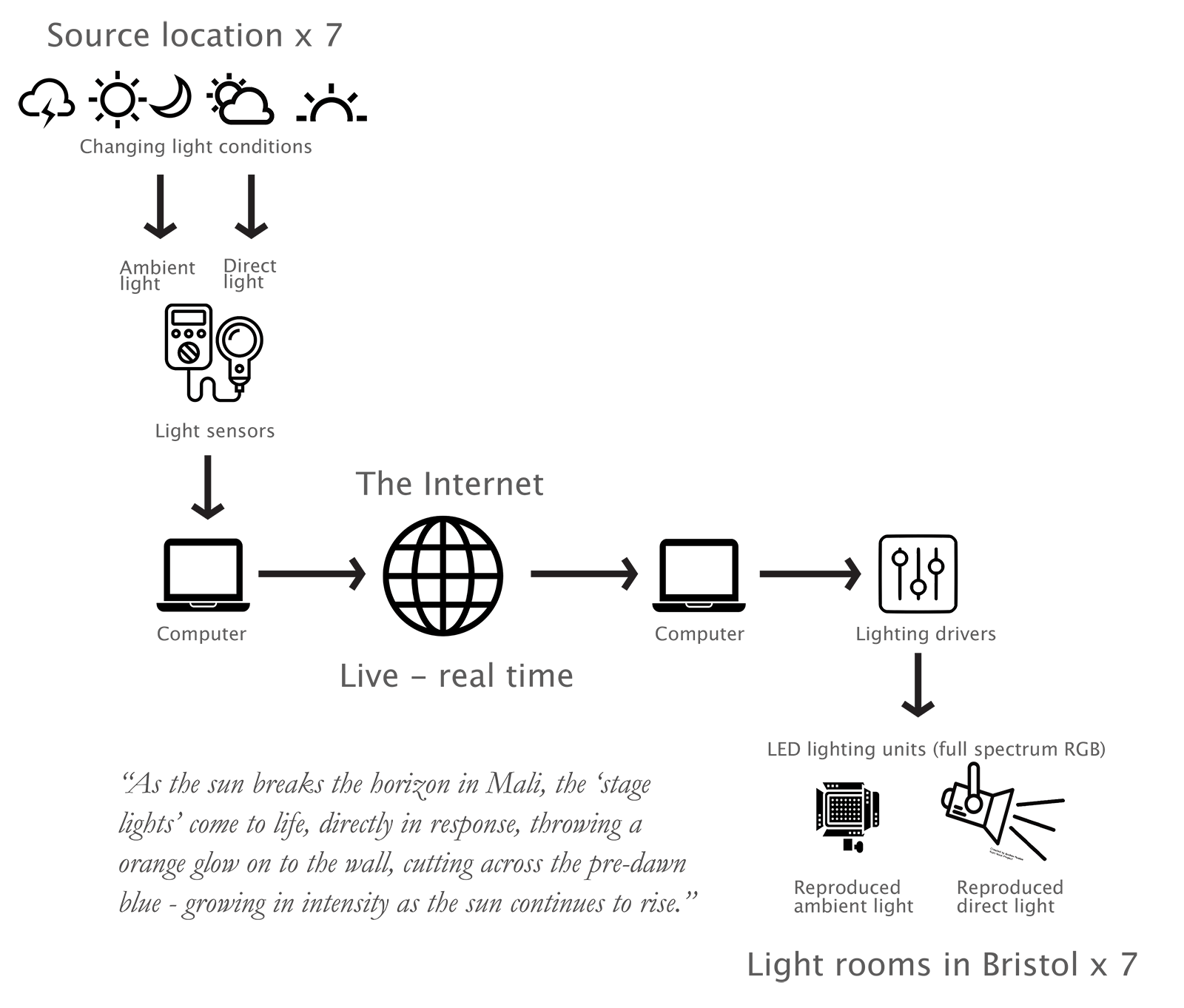
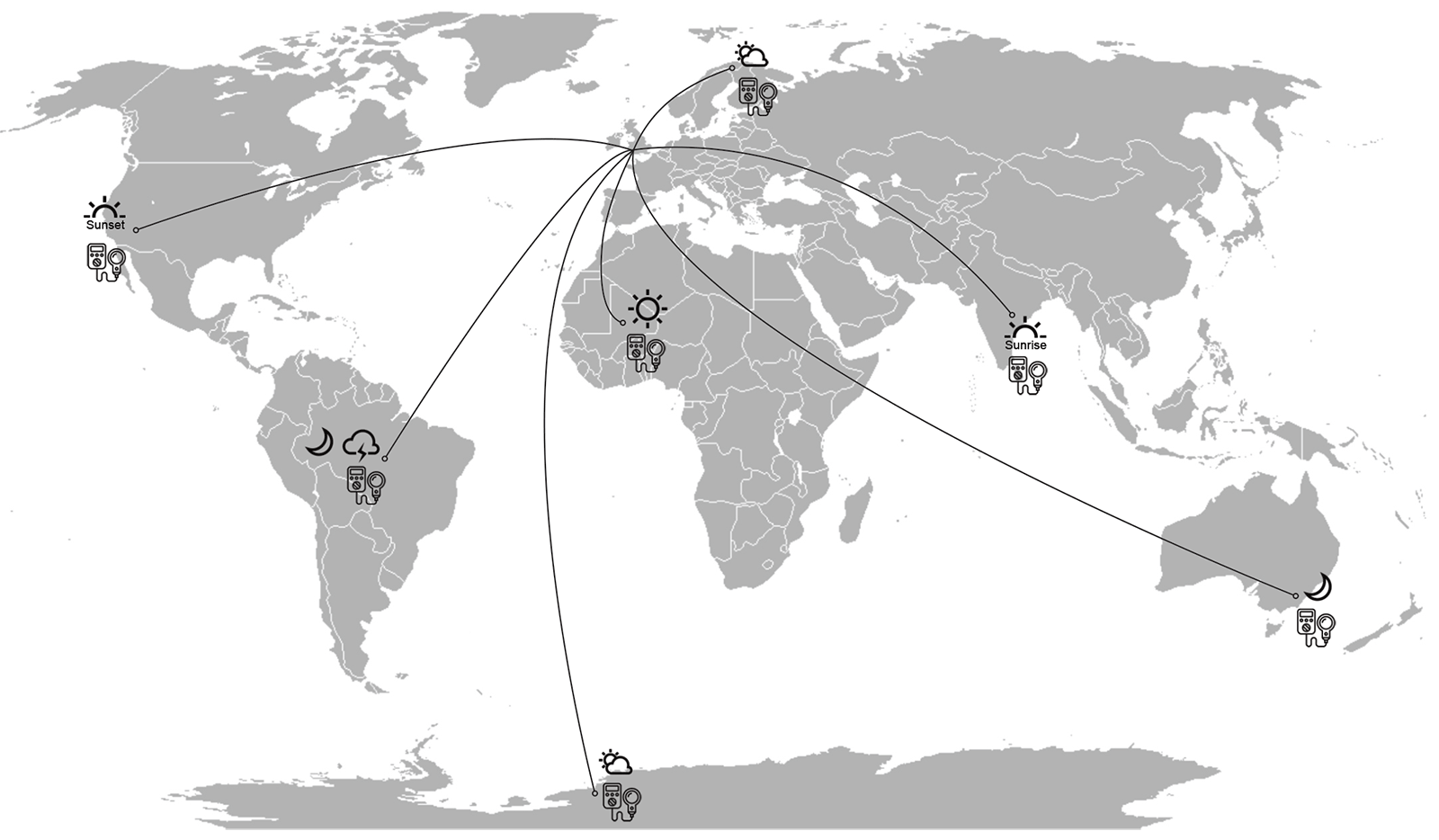
Seven rooms filled with constantly shifting light respond directly to the changing light conditions at seven remote locations around the world. Light data, picked up by sensors at thesources locations is relayed back to a warehouse in Bristol in real-time and recreated, on the fly, using RGB lighting units. As the colour and brightness of the light shifts throughout the day and night at each source location, so the quality of light in each room will change accordingly, as the earth turns on its axis.
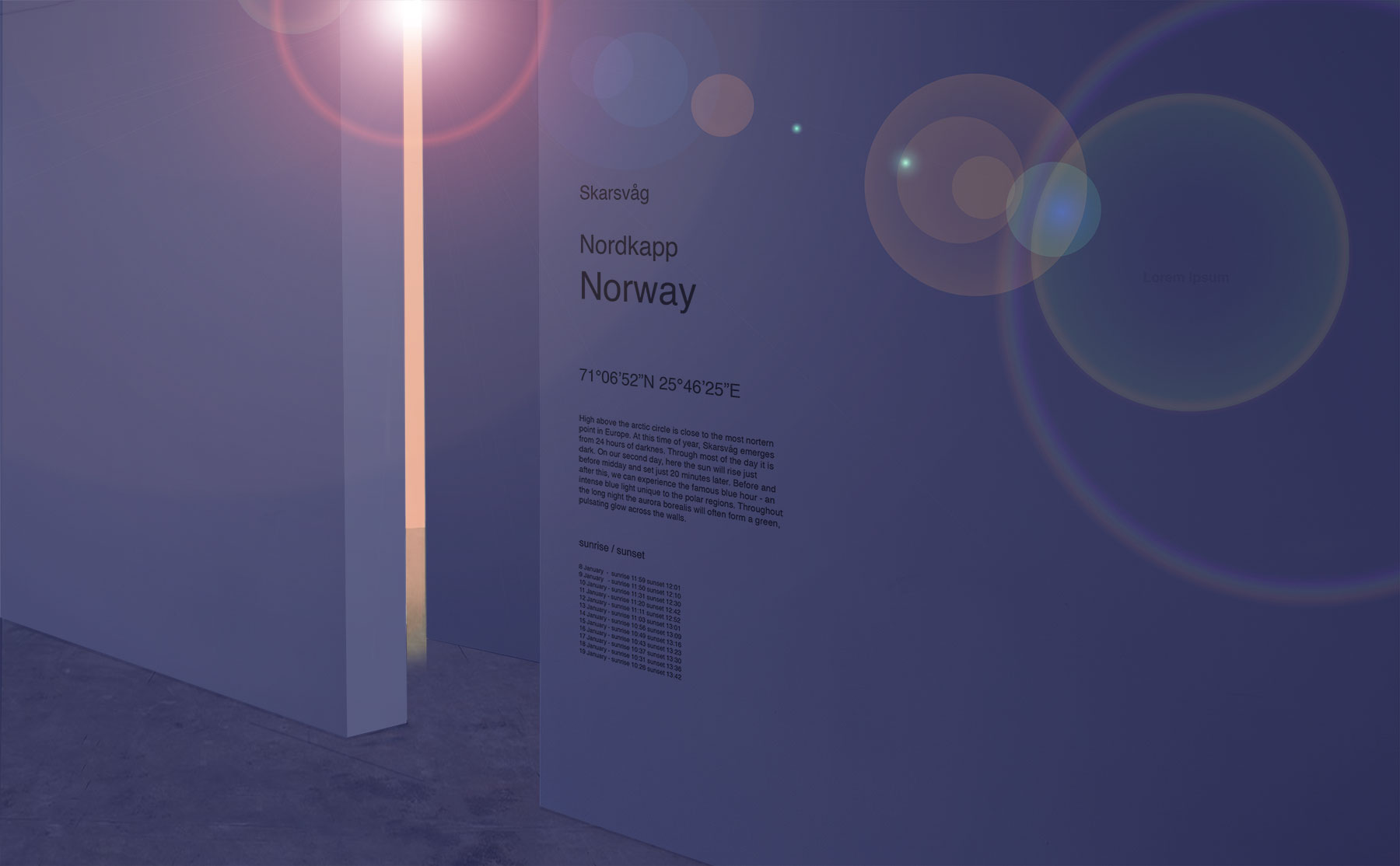
Inside the warehouse spaces the audience will be able to move from room to room, jumping from the dazzling sun of the Rajasthan desert to the inky darkness of the Brazilian night; or experience the fleeting rays of the sun as it momentarily breaks the horizon before disappearing again, deep in the Arctic winter.
THE PROJECT
At seven locations in far-flung corners of the world, illuminance spectrophotometers will be set up, pointing towards the open sky*. They will pick up the unique, continuously changing, light conditions at each location. The colour and brightness of both ambient daylight and direct sunlight (where it is present) will be picked up by the sensors. This data will be relayed back to Bristol in real-time via the Internet.
In a series of 7 light-proofed rooms inside a warehouse on Bristol’s Harbourside, this ‘live’ data will be instantaneously converted back in to light of the same colour and relative intensity, using full spectrum, colour changing LED lighting units. As the colour and brightness of the light shifts throughout the day and night at each source location, so the quality of light in each room will change accordingly, replicating the conditions at the host location. A combination of lighting unit types will be used to reproduce both diffuse ambient light, and beams of direct sunlight. The project will run continuously, 24 hours a day for 12 consecutive days.
A slight mist (glycerine haze) will be used to help diffuse the light and blur the walls and ceilings creating the illusion of more expansive space. As the light in each room constantly changes, so the relationship between the rooms will shift. While one room goes from darkness, through the indigo of pre-dawn, to the rose of sunrise, another room might be in near darkness with faintest glow of starlight; and another filled with intense dazzling ‘sunlight’.
“As the sun breaks the horizon in Mali, the ‘stage lights’ come to life, directly in response, throwing a orange glow on to the wall, cutting across the pre-dawn blue – growing in intensity as the sun continues to rise.”
As well as the astronomical phenomena of day and night the quality of light in the rooms will also respond to weather and atmospheric conditions such as light pollution, aurora, dust in the atmosphere, lightening and darkening as clouds pass and flashes of lightning.
Conceptually the project suggests the compression of global space. A place where it will be possible to experience the dwindling light as the sun sets in one room and the growing intensity of light as it simultaneously rises in another hints at the smallness and fragility of our planet.
Seven Skies aims to evoke different moods and experiences in the audience. At times it will be playful: visitors can move from room to room and jump between time zones, and atmospheres and times of day. At other times the slowly changing light will create a more peaceful meditative atmosphere where people can sit on cushions and benches (provided) and become immersed in the glowing fields of colour or dark night skies from remote parts of the world.
“High above the arctic circle as the landscape is plunged in to the deepest pre-dawn blue, unique to the polar regions, room 2, in turn becomes immersed in a glowing ultramarine”
Sunset and sunrise times along with various predicted events such as aurora and lightening storms will be published on the project website. Up do date weather forecasts will also be written on and on whiteboards at the entrance to each room.
Whilst the ‘rooms’ are intended to be immersive environments and generate moods and atmospheres of far away places, they will also be clearly artificial and an abstraction of the source light conditions – and as such the technology used recreate these abstracted shifting lightscapes will also be part of the story.
“Blinding strobes of light suddenly cut through the darkness and flash across the walls as lightening storms light up the night sky above Manacapuru, Brazil”